
When should an expert be brought into a dispute?

A 2026 CIArb report on party-appointed expert witnesses in international arbitration suggests that experts are often brought into disputes later than they should be. The findings are about arbitration, but many of the issues will be familiar to those involved in conventional litigation as well.

Party-Appointed Expert Witnesses in International Arbitration: Effectiveness and Best Practice draws on 419 responses from expert witnesses, arbitrators, external counsel and in-house counsel, together with consultation across common law and civil law jurisdictions. One of its central themes is the timing of expert involvement. Some 71% of respondents thought that, ideally, experts should be appointed before the arbitration itself had begun: 42% once the issues between the parties were known or had crystallised and 29% before a claim was made.

The figures become more interesting when the responses of experts are compared with those of the people instructing them. Only 44% of expert witnesses thought they were typically given enough time to carry out their work. External counsel were considerably more optimistic at 66%, arbitrators at 77% and in-house counsel at 80%. Some 60% of the experts also thought they should have an opportunity to comment directly on the procedural timetable when it is being set.

There was a similar difference of view about why experts are instructed late. Among experts, 42% identified a lack of understanding of the expert’s role and 39% identified cost. External counsel saw cost as the principal problem, at 53%, while only 13% thought lack of understanding of the expert’s role was the main reason.

Those figures come from international arbitration, but the underlying question is wider: are we sometimes concentrating too much on the date by which the expert report is needed, rather than the point at which the expert might usefully become involved?

What can an expert add before the report is due?

Bringing an expert in earlier does not necessarily mean commissioning a full report earlier. There is useful work which may need to happen long before anybody starts drafting one.

An expert may be able to identify whether the technical question being posed is actually the right one, what evidence or data will be needed to answer it, whether important material is missing and whether the proposed timetable bears any relation to the work required. In some disputes the expert may also be able to test whether a claim or defence which looks attractive in legal terms works when the underlying technical, scientific or financial assumptions are examined.

The CIArb report identifies early involvement as potentially helping to test the viability of claims, clarify technical issues, narrow areas of disagreement and inform procedural planning. It also raises the practical difficulty of experts being presented with a timetable once it has already been agreed and then being expected to work within it.

This can become particularly important where several disciplines depend upon one another. A quantum expert, for example, may need findings or opinions from an engineering or delay expert before parts of the quantum analysis can sensibly be completed. If those dependencies are only discovered after individual report deadlines have been fixed, somebody is likely either to duplicate work or to run out of time.

The same issue arises in litigation

In England and Wales, CPR Part 35 requires a party seeking permission for expert evidence to identify the field in which the evidence is required and the issues which it will address. Where practicable, the proposed expert must also be identified. Practice Direction 35 separately requires parties to consider with their experts at an early stage whether an experts’ discussion is likely to serve a useful purpose and, if so, when it should take place.

By that stage some fairly important decisions may already be taking shape. What is the expert issue? Is one discipline enough? Will more than one expert be needed? What material will each expert require? Is sequential evidence sensible? Should the experts meet before or after reports?

Our own Guidance on Joint Statements reflects the fact that there is no single correct sequence. In some cases an early meeting between experts can expose differences in methodology, assumptions or source material before substantial costs are incurred. In others, particularly less complex cases, exchanging reports first may lead to a more focused discussion.

The appropriate sequence depends on the dispute and the evidence. What matters is that it is considered rather than allowed to happen by accident.

Different approaches in different jurisdictions

There is no universal model for expert evidence. This is particularly relevant in international arbitration, where participants may come from very different procedural traditions and the arbitration itself may combine elements which would be unfamiliar in the domestic courts of any one jurisdiction.

Australia provides an interesting comparison. The Federal Court expects parties proposing to use expert evidence to consider at an early stage how that evidence should be managed. Its Expert Evidence Practice Note deals with matters including the questions to be addressed by experts, conferences between experts, joint reports and concurrent expert evidence.

Australia is particularly associated with concurrent expert evidence, sometimes known as the “hot tub”, under which experts may give evidence together and address particular issues in turn. That can make expert involvement part of the management and narrowing of the technical dispute rather than simply a sequence of reports followed by separate cross-examinations.

Singapore takes a rather controlled approach to the use of expert evidence. Under the Rules of Court 2021, expert evidence cannot be used without the Court’s approval. The parties must consider whether it will materially contribute to deciding an issue involving scientific, technical or other specialised knowledge and whether the issue could instead be resolved through agreed facts or agreed materials.

The Singapore courts also require the parties, as far as possible, to agree on a common expert, and the issues to be referred for expert evidence and the agreed or assumed facts are themselves subject to close control. The Singapore Judiciary provides a useful summary of the expert evidence provisions.

Hong Kong also requires permission before expert evidence is adduced in civil proceedings. An application is normally made after pleadings have closed and should identify the area of expertise and the issues on which expert evidence is required. Parties are also expected to consider whether a single joint expert would be appropriate. The Judiciary summarises the process in its guidance on preparing for a hearing or trial.

In US federal litigation, the structure is different again. Rule 26 of the Federal Rules of Civil Procedure requires disclosure of testifying experts and, for retained experts, detailed written reports. The timing is normally set by the court; if it is not, the default deadline is at least 90 days before trial, with a shorter period for rebuttal evidence. That is a disclosure deadline rather than a rule about when the expert must first be retained, and experts in substantial cases may of course be involved considerably earlier.

These differences make “instruct the expert earlier” rather too simple as a universal rule. Some systems favour early involvement of party-appointed experts; others put more emphasis on defining the expert issues first, limiting the amount of expert evidence or considering a common or single joint expert.

The point which travels rather better between jurisdictions is that expert evidence should be considered early enough for the procedure to fit the evidence, rather than forcing the evidence into a procedure which has already been fixed.

Earlier involvement does not mean losing independence

There is an obvious concern in bringing an expert into a dispute at an early stage. A party-appointed expert witness is not another member of the legal team and should not become an advocate simply because they have been present while the case is developing.

But there is a difference between asking an expert to construct the client’s case and asking the expert whether the case being contemplated can be supported within their field of expertise.

An expert may quite properly say that a proposed methodology will not work, that the available data is inadequate, that another discipline is required or that an assumption on which the claim is being built is technically unsustainable. Finding that out before pleadings are settled and directions are agreed may be considerably more useful than discovering it three weeks before the expert report is due.

The capacity in which the expert is instructed also matters. An expert retained privately to advise a legal team performs a different function from an expert who is to give independent evidence to a court or tribunal. The distinction between advisory or “shadow” experts, party-appointed expert witnesses and single or common experts deserves separate treatment, particularly because duties, disclosure and privilege can differ between jurisdictions.

Start with the expert evidence, not just the expert report

The CIArb research does not suggest that every expert should be appointed at the beginning of every dispute. The appropriate approach will depend on the dispute, the tribunal or court, the jurisdiction and the type of expert evidence required.

It does suggest that leaving consideration of expert evidence until the case has already been designed can create problems which are difficult to repair later. Timetables may prove unrealistic, necessary evidence may not have been preserved or obtained, different expert disciplines may have been sequenced badly and the questions eventually put to the expert may not be the questions which actually need answering.

That should sound familiar outside arbitration as well.

When a dispute is likely to depend materially on expert evidence, the useful question may not be simply “When do we need the report?”

It may be worth asking rather earlier: “When do we need the expert?”

Further reading: CIArb, Party-Appointed Expert Witnesses in International Arbitration: Effectiveness and Best Practice.

When expert opinion becomes advocacy: lessons from KS v Secretary of State

An expert is perfectly entitled to reach a strong opinion which supports the case of the party instructing them. The difficulty is when the reasoning appears to work the other way round, with the party’s case driving the expert opinion.

That distinction arose in KS v Secretary of State for the Home Department, where First-tier Tribunal Judge Froom considered expert evidence about conditions in Tajikistan. His criticisms ranged from whether the expert had demonstrated the necessary expertise through to the sources relied upon and the extent to which the appellant’s account had been independently examined. By the end of that analysis, the Judge’s view was that the expert was advocating for the appellant rather than providing critical and objective expert evidence.

The limits of an expert’s expertise

The expert described himself as a publicist, PR expert, television presenter and journalist specialising in Russia and post-Soviet states. He held degrees in international law and marketing and had written extensively for newspapers and websites.

The Tribunal was concerned about how much of that experience demonstrated expertise specifically in Tajikistan. Judge Froom noted that the expert did not appear to have visited the country, had held no academic post and listed only one publication, which concerned Russia. He concluded that sufficient expertise on Tajikistan had not been demonstrated.

This is an issue which can easily arise where someone has genuine expertise across a broad subject or geographical area. The question is not simply whether an expert is knowledgeable, but whether their knowledge and experience extend far enough to support the particular opinions they have been asked to give.

Checking the sources

Some of the most striking criticism concerned the source material.

The report stated that honour crimes were deeply ingrained in Tajik culture, particularly in rural areas, and cited four sources. Two dealt with domestic violence against women and the Tajik government’s response, another with religious freedom and the fourth was the Criminal Code of Tajikistan.

“I was not able to find any reference to honour crimes in any of these documents.”

Counsel was invited to identify such a reference and was also unable to do so. Judge Froom described the failure accurately to source the assertions about honour crimes as a “serious flaw in the report”.

The question of sources also arose in SU (Expert reports – format) Bangladesh [2026] UKUT 317 (IAC), which we considered in our article Online sources are not the expert opinion.

In SU, the Upper Tribunal emphasised that material relied upon should be identifiable and capable of being checked, and that experts should go back to the primary source wherever possible. The report must also distinguish between the underlying material and the expert’s own analysis and opinion.

KS illustrates the problem from a slightly different direction. Identifying a source is not enough if the source does not actually support the proposition for which it is being cited. The two decisions therefore fit rather neatly together. In SU, the emphasis was on making the source material transparent and traceable; in KS, the Tribunal was able to trace the sources and found that they did not support an important assertion in the report.

For experts who rely on academic papers, technical literature, industry publications, statistics or other external material, the practical discipline is much the same. The reader should be able to identify what has been relied upon, find it if necessary and understand what the expert says it establishes. A citation does not acquire authority merely by appearing in an expert report.

Assumptions and the client’s account

The Judge was also concerned about the way in which the expert dealt with information provided by the appellant.

Claims had been made about the influence of members of a particular family. The expert did not say that he had investigated those individuals or independently established the extent of their influence. Judge Froom said that the expert:

“simply accepts what the Appellant says and agrees with him”

and concluded that this did not assist the Tribunal.

Expert reports will often depend upon factual assumptions supplied by those instructing the expert. There is nothing unusual about that, and in many cases the expert will have no means of establishing those facts independently. What matters is being clear about the distinction between an assumed fact and something the expert has independently established, and not presenting the former as though it were the latter.

There is an interesting contrast elsewhere in the judgment. Judge Froom identified an issue concerning the alleged police search on which expert evidence might have assisted the Tribunal, but the report did not address it. The report therefore ventured into areas which concerned the Tribunal while leaving unanswered a question on which the expert might have been able to provide useful assistance.

When opinion becomes advocacy

Against that background, Judge Froom said:

“The distinct impression gained is that Mr Kharitonov is simply advocating on behalf of the Appellant”

rather than providing a critical and objective expert opinion. He went on to say that the expert “trespasses into the role reserved to the Tribunal”.

An expert does not preserve their independence by avoiding firm conclusions or carefully balancing every opinion. If the evidence leads strongly in one direction, the expert should say so. Independence lies in the process by which the opinion is reached: considering the relevant material, testing assumptions where appropriate, acknowledging the limits of the expert’s knowledge and allowing the evidence to determine the conclusion.

Seen together, the criticisms in KS explain why the Tribunal became concerned about advocacy. Questions about the expert’s specific expertise would not necessarily lead to that conclusion on their own. Nor would one poorly chosen citation. But where important assertions are unsupported by the sources cited, the client’s account is accepted without sufficient examination and opinions move into matters for the Tribunal, the cumulative effect can be rather different.

Judge Froom attached no weight to the report as expert evidence.

For anyone preparing an expert report, KS is a useful illustration of why independence has to be apparent throughout the report. It can be seen in the treatment of instructions and assumptions, in the selection and checking of sources, in recognition of the limits of the expert’s own expertise and, above all, in whether the reasoning genuinely leads to the opinion rather than being used to support a conclusion already reached.

Read the judgment: KS v Secretary of State for the Home Department on Find Case Law.

Changing Roles: When a Contractor Becomes an Expert Witness

A High Court decision provides a useful warning for professionals who become expert witnesses in matters in which they have already been involved.

In MSA Properties Ltd v The Drapery Northampton Ltd [2026] EWHC 1420 (KB), the court had to resolve a dispute concerning deteriorated structural joists in a building in Northampton. Both parties relied on structural engineering evidence.

The point of wider interest for experts concerns the defendant’s expert, who had already been involved in the matter before the litigation.

He inspected the building in 2023 and produced a report for the defendant. That report was not prepared as expert evidence for the proceedings. By 2025, however, he was acting as the defendant’s expert witness.

That change of role became important.

The judge noted that the later expert report did not refer to the earlier inspection or the report produced at the time, despite the expert accepting in oral evidence that the earlier inspection had given him a better view of the joists.

The court was also critical of the extent to which he had engaged with the available evidence and of the opportunities available to him to inspect the property more fully.

The most significant criticism was the judge’s observation that his approach reflected:

“some conflation of his role as a contractor engaged in negotiations with the Claimant and his duties as an expert witness”

There was no suggestion that the expert had deliberately acted partially. The concern was rather that aspects of his earlier role appeared to have carried over into the way he approached his later expert evidence.

That is a useful warning for any professional who changes role during the life of a dispute.

Previous involvement does not automatically prevent someone from later acting as an expert witness. In some cases, that earlier involvement may mean they have valuable knowledge of the subject matter.

But the nature of the role changes.

A contractor, consultant or adviser may previously have been helping a client solve a problem, negotiate a position or achieve a particular commercial outcome. An expert witness has a different duty.

Under CPR 35.3, an expert’s duty is to help the court on matters within their expertise. That duty overrides any obligation to the person from whom they have received instructions or by whom they are paid.

That is not simply a formal statement to be repeated in the declaration at the end of a report. It has practical consequences for the way an expert approaches the evidence.

Transparency about previous involvement

Where an expert has already inspected the subject matter, produced reports, advised a party, taken part in negotiations or expressed views before being instructed as an expert witness, that history may be material to the opinion now being given.

The point is not that every earlier conversation or document must automatically be reproduced. It is that relevant prior involvement should not be left invisible if it bears on the expert’s present reasoning.

That is particularly important because CPR 35.10 requires an expert report to state the substance of all material instructions, whether written or oral, on the basis of which the report was written. Practice Direction 35 also requires the expert to make clear which facts are within their own knowledge and which have been provided by others.

In this case, the earlier involvement was not peripheral. The expert had inspected the joists at a time when they were more fully exposed and had produced an earlier report. He later accepted that the earlier inspection had given him a better view of the joists, yet neither the inspection nor the earlier report appeared in his expert report.

That is a useful illustration of why disclosure matters.

If earlier involvement has informed what the expert knows, assumes or concludes, the court should be able to see that route clearly. If it only emerges later, particularly in cross-examination, the omission can create an avoidable question about the completeness and transparency of the expert’s reasoning.

For an expert changing role, a sensible question at the outset is:

What have I already done, seen, said or concluded in this matter, and what of that is material to the opinion I am now giving?

If someone changes role during the life of a dispute, earlier assumptions may need to be revisited. Previous opinions should not simply be carried forward without being tested against the evidence now available. Earlier inspections, reports and involvement may themselves be relevant and should be dealt with openly where necessary.

The wider framework of the Civil Procedure Rules matters as well.

The overriding objective in CPR 1.1 is to enable the court to deal with cases justly and at proportionate cost. Expert evidence forms part of that process. It is therefore not enough for an expert merely to possess relevant expertise. The evidence has to assist the court in a way which is independent, properly reasoned and proportionate to the issues in dispute.

That is why a change in role can be important.

A professional may quite properly have spent months or years advising a client, negotiating with another party or working towards a particular practical outcome. Those activities may require judgement, persuasion and a close identification with the client’s interests.

The expert witness role is different.

Once instructed as an expert, the professional must be able to step back from that earlier involvement and approach the evidence independently. That may mean reconsidering previous views, acknowledging matters which do not support the client’s position and making clear where earlier involvement has informed the present opinion.

  • The Academy’s guidance on party-appointed experts explains the overriding duty owed by an expert to the court.
  • The Academy’s Code of Practice for Experts places independence, impartiality, objectivity and integrity at the heart of expert practice.
  • The Academy’s Model Form of Expert Report is also relevant where an expert has had previous involvement, because the report should make clear the factual basis of the opinions expressed and the material relied upon.

The lesson from MSA Properties is not that previous involvement disqualifies an expert. It is that a professional who moves from contractor, adviser or negotiator to expert witness must make that transition consciously and transparently. The court may look closely at whether the expert has genuinely separated the new role from the old one, and whether the report gives a clear account of any earlier involvement which bears on the opinion now being expressed.

For experts, that is a useful point to consider before accepting instructions in a matter in which they have already been involved.

See the judgment here on BAILII.

Are you being recorded? Experts should take care to understand the available technology.

No doubt at least some members will have received some shiny new tech gadgets in their Christmas stockings, but as you  get to know the latest toys we start 2026 with a reminder to be aware of the possibility that meetings may be recorded without your knowledge.

In a recent case involving  expert neuro-psychological tests relating to a whiplash injury (Celikdemir v PGR Timber Ltd) it transpired that the claimant, despite being asked to turn off her phone, had continued to record the examination using a smart watch on the advice of her solicitor.

This was despite both legal teams having formally agreed that the tests would not be recorded and the solicitor in question stated that  at the time of giving this advice “I was oblivious of the agreement at the CMC a year earlier not to record the neuropsychological testing. Had I been cognisant of that agreement, that would have swayed me into advising the claimant not to record and simply to run the risk of not having the backup of a recording.”

The existence of the recording became significant because there was an argument about whether background noise had impacted the tests and at first glance it seemed there was an imbalance between the experts, since one had the client’s covert recording and the other did not. But in a final twist it transpired that the software used to record the results of the test had automatically being taking an audio recording without the experts knowledge. This was retrieved and the experts were able to revert to a level playing field.

The message for experts is twofold. Firstly, if recordings are not to be taken make sure the client has turned off ALL possible devices and secondly make sure you know what the software you use is doing!

Our picture is from Reolink

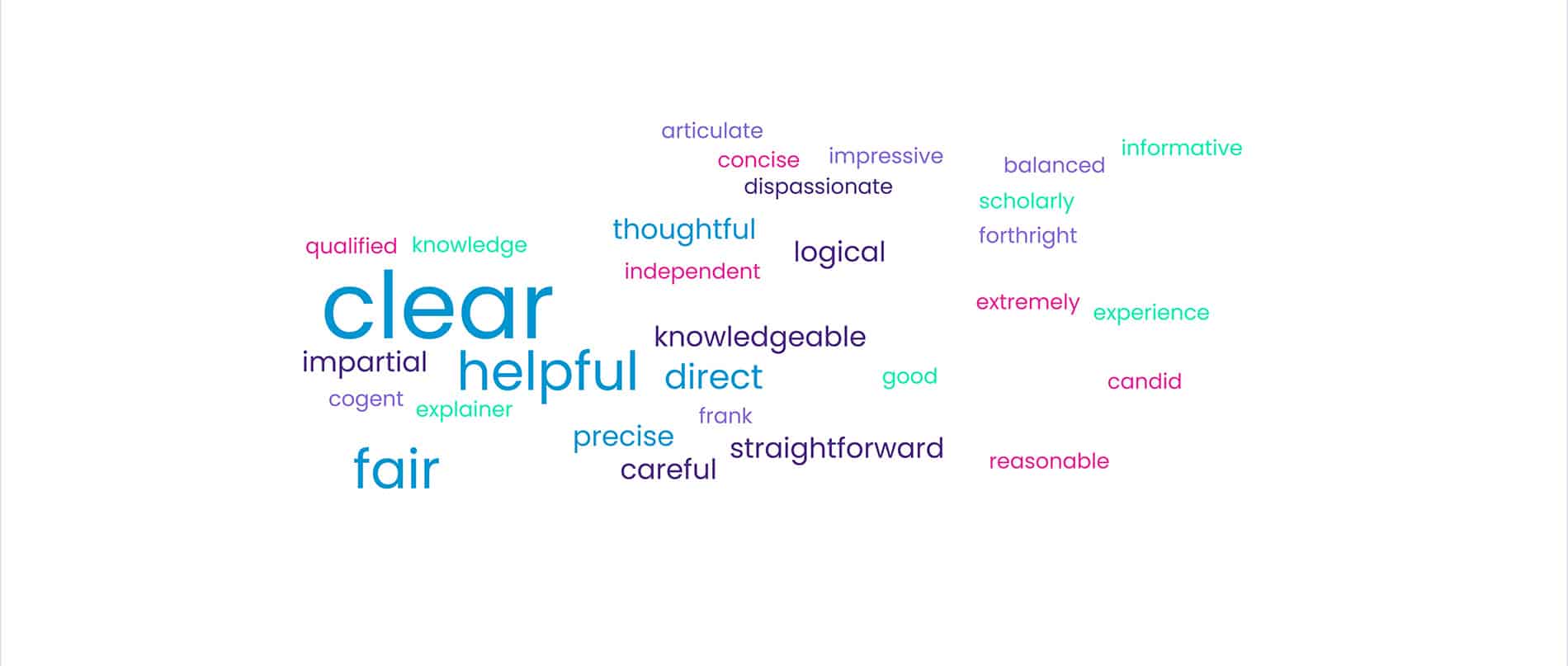
Good experts are all alike – clear, helpful and fair

As Tolstoy might have said if writing about litigation rather than Anna Karenina,  “All good experts are alike; each poor expert is unhelpful in their own way”. There have been some notable examples of poor experts over the past year, from those who simply don’t have the right expertise or understanding of their role to those (thankfully very unusual) experts who understand the role perfectly but have chosen to fight their client’s corner rather than help the court.

Judges understandably spend more time explaining why they don’t accept an expert’s evidence than praising experts who, from the court’s perspective, are simply doing the job they are supposed to do. Often the only feedback a good expert gets is a few positive words but our word cloud summarising this year’s comments demonstrates that good experts have some very simple things in common. From a judge’s point of view they are clear, helpful and fair. To give some colour to that perhaps obvious statement, here are a few of the more loquacious judicial comments about experts from 2025;

  • This was unquestionably an impressive expert. He had a ready command of the details both of the market at the time and of the issues in this case. He was fair minded and demonstrated the independence that makes experts so valuable to the court, readily recognising criticisms of the Valuation and his own methodology where he considered them to be fair. At times I felt that the Claimant verged on, and indeed strayed into, conducting trial by ambush in the course of the cross examination, presenting him with new material while in the course of giving evidence; he engaged with the new figures presented to him and was able to offer clear, comprehensive answers to the questions put.
  • It is clear that each of the 12 expert witnesses had a wealth of qualifications, experience and/or expertise in their respective disciplines and used their understanding and knowledge to assist the Court. The Court is immensely grateful to them.
  • Whilst she had less experience to give technical evidence on the main issues in this dispute her oral evidence was thoughtful and helpful.  She was at all times mindful of her overriding duties to the court and gave clear answers to the difficult questions put to her.
  • The court greatly benefited from the expertise and thoughtful consideration of two eminent consultant surgeons. It was undoubtedly the right decision to grant permission for their testifying. They were rather different personalities, but each possessed intellect and were articulate, frank and forthright – precisely what the court would expect of high-quality experts. The court is grateful to them both.

Such comments are a reminder that as well as specialist professional skills and qualifications experts need the ability to communicate clearly both in writing and verbally, especially in court. The legal environment is very different from ‘normal’ professional practice so anyone considering acting as an expert needs to understand that environment,  the rules that apply to expert evidence and how to avoid the pitfalls that can lead to a difficult time in court and potentially public criticism from a Judge.

The Academy’s training programme is designed to help already  skilled professionals through the basic foundations to a mock cross-examination to ensure that they are fully prepared. Our training courses are primarily delivered online but we run some face to face courses  in London and Hong Kong. We can also run in-house training for larger consultancies, please contact us for details.

Members receive a 25% discount on training, if you would like to join the Academy please complete our Pre-Application Questionnaire and we will help you identify the appropriate membership level for you. Other benefits of membership include guidance and advice on being an expert, regular member meetings to discuss issues affecting experts and access to specialised PI insurance.

Searching for evidence. A reminder to experts of the need to look thoroughly.

Experts  often have to rely on their clients and instructing solicitors to provide them with the material they need to form opinion. That evidence may be documents, data from an IT system or audio or video recordings and if the evidence you are given is incomplete or distorted in some way your opinions may turn out to be wrong.


The Chief Constable of Northamptonshire Police has recently been found in contempt of court in a case that acts a timely warning to experts of the need to check and check again that you really have all the evidence you need.


A brief summary of the case is that a woman was arrested and charged by police officers but the case against her was then dropped. She was unhappy with the way she had been treated during the arrest and claimed that property had been taken. Cue a series of court cases escalating through the courts and requests under GDPR for access to the video recordings from the police officers’ body worn cameras. Complaints to the ICO were upheld and some footage provided but not all of it and Northants police claimed on multiple occasions that  they had ‘performed standard searches’, had provided all the available material and that any remaining footage had been deleted without any clear explanation of why.


A few days before a final hearing at the Court of Appeal it transpired that when the audit logs for the relevant officers were checked and other, entirely obvious but presumably not ‘standard for Northants police’ searches were carried out the missing video footage did in fact exist, had not been deleted and could be provided without any difficulty.


The lesson for experts is that when a client says they’ve looked for and not found the evidence you expect to see you should treat them like a teenager who claims not to be able to find a missing pair of trainers. Get them to tell you exactly and in annoying detail where they’ve looked, what searches they’ve performed and if humanly possible make them show you what they’ve done. If there’s  really nothing there then there’s no problem, but if you emerge from under your client’s metaphorical bed with a pair of smelly trainers it really is better to know sooner rather than later!


As well as specialist professional skills and qualifications experts need the ability to communicate clearly both in writing and verbally, especially in court. While many consultants and professionals have those skills the legal environment is very different from ‘normal’ professional practice. Anyone considering acting as an expert needs to understand that environment,  the rules that apply to expert evidence and how to avoid the pitfalls that can lead to a difficult time in court and potentially public criticism from a Judge.

The Academy’s training programme is designed to help already  skilled professionals through the basic foundations to a mock cross-examination to ensure that they are fully prepared. Our training courses are primarily delivered online but we run some face to face courses  in London and Hong Kong. We can also run in-house training for larger consultancies, please contact us for details.

Members receive a 25% discount on training, if you would like to join the Academy please complete our Pre-Application Questionnaire and we will help you identify the appropriate membership level for you. Other benefits of membership include guidance and advice on being an expert, regular member meetings to discuss issues affecting experts and access to specialised PI insurance.

3 Unwise Experts. Independence means hearing, seeing and speaking the ‘evil’ in your client’s case

The High Court ruling against Danish tax authority SKAT in a £1.4 billion dividend tax fraud case has been widely reported, not least because the judge concluded that SKAT’s controls on the transactions involved were so flimsy as to represent the equivalent of a ‘help yourself’ sign outside a bank.


Less attention has been given to the judge’s criticisms of the experts who appeared on behalf of the many parties involved. As he put it “ All three experts, in differing ways, did not provide properly balanced written reports”.


Perhaps the clearest example was SKAT’s expert “whose written work was argument rather than expert evidence” showing the dangers of working closely with a client and legal team on complex, long-running litigation. The judge concluded that “he finds it difficult not to think and express himself as an advocate for SKAT’s position. He has, I think, lost detachment from the partisan interests of SKAT” and was unable perhaps to hear any ‘evil’ in his client’s case.


Somewhat less concerning was an expert whose testimony was careful but tended to obscure his views and maximise differences with other experts that were not a pronounced as appeared at first glance.  As the judge observed, “That exposed him to a cross-examination that should have been largely unnecessary to confirm the extent to which, in substance, he agrees with a range of matters on which SKAT relied. “ Fortunately he appears to have dealt with that cross-examination impressively, fairly (with balance), and with an obvious depth of thought and expertise. A better approach might have been to write a report that allowed the parties to see more clearly.


And finally, the third expert’s generally much better approach (once his reports had been edited to remove contentious factual matters that should not have been there!) and thoughtful and fair answers to questions were undermined by his taking a view in the witness box that he had not expressed in writing.  The judge concluded that his interpretation of a key terminology expressed in oral evidence “had not been his view at any material time. It was inconsistent with the views he had expressed in writing, including in his primary expert report in these proceedings, to which he had to proffer alterations when called to give his oral evidence to advance the different view. “  While the case did not turn on this point the judge made it clear that speaking out in this way, because his written views in fact assisted the other side, was not acceptable and did the expert no credit.


The message to experts should not be a surprise, no client’s case is perfect and there are times when your views will not support their case. When that happens it is critical that you make sure your client’s hear you, that the court can see hat your views really area and that when you speak you keep your duty of independence firmly in mind.

Anyone considering acting as an expert needs to understand that environment,  the rules that apply to expert evidence and how to avoid the pitfalls that can lead to a difficult time in court and potentially public criticism from a Judge.

The Academy’s training programme is designed to help already  skilled professionals through the basic foundations to a mock cross-examination to ensure that they are fully prepared. Our training courses are primarily delivered online but we run some face to face courses  in London and Hong Kong. We can also run in-house training for larger consultancies, please contact us for details.

Expert gold dust. Agreed expert evidence benefits the court and the parties.

Most discussion (and criticism) of experts revolves around issues where experts disagree, often in ways that are pivotal to a case.  But there are many cases that go unnoticed where experts agree on most, if not all, of the important issues, which for the most part is what you would expect from professional experts given the same set of facts and questions.


The value of agreed evidence was highlighted in a recent professional negligence case involving a very unpleasant spinal condition called Cauda Equina.  Working through all the issues  required evidence from experts in GP practice , neurosurgery, urology, psychiatry, neurorehabilitation, physiotherapy and occupational therapy. It’s evident from the judgement that most of the experts involved were experienced  professionals and the judge was greatly assisted by the extent to which evidence was agreed as shown by these quotes;


“I found both to be clear and helpful in their evidence and each engaged with the questions they were asked and sought to assist the Court with their answers. Each also made appropriate concessions. Most importantly, as they stated in the Joint Statement dated 31 July 2024, they agree all of the most important points.”

“I accept all of this agreed expert evidence, as does each of the parties. “

“Neither expert was cross examined for long as they are essentially agreed on all significant points. Both gave their evidence in a clear way and made appropriate concessions. I accept their evidence. “

“I accept all of the agreed expert evidence.”


“Both gave oral evidence at trial, although at no great length given the extent of the agreement between them as to the most important matters of urology in the case. I found both to be impressive witnesses, giving clear and direct answers to questions with helpful explanations where necessary. Each also made appropriate concessions. “


In contrast in a complex case involving bribery and corruption relating to oil exploration (Aabar v Glencore) an expert in Dutch law appears to have viewed the idea of agreeing with another expert as problematic. The issue concerned involved whether disclosure of certain materials would result in a criminal prosecution in the Netherlands. In his first report the expert treated disclosure of the FIOD documents as something that might amount to an offence. In a later report responding to the other expert, he reached a stronger conclusion. The judge was not satisfied that this change, or the firmer view about the risk of prosecution, had been justified.


As the judge commented while “it is understandable (as occurs with lawyers) to firm up one’s views after further analysis and consideration, experts are instructed to give their independent expert opinion, and are under a professional obligation to explain and justify any change of opinion. In this context it is somewhat strange that views expressed without considering another’s expert report should then be expressed in very much stronger terms after reading the report of another expert who expresses a contrary view with which the first expert disagrees.” His view was that the unexplained shift in ground called into question the reliability of the expert’s evidence.

The message for experts is to remember that your opposite number is not an enemy and that you should both, in most cases, hold the same opinions if presented with the same facts and questions. There may be good reasons for disagreement but disagreeing for the sake of it or to support your client’s case does not help the court nor in the long run you or your client.


For advice and guidance on meetings of experts and agreed statements of expert evidence check out the guidance in the Academy’s Knowledge Hub.

Updated 5 November 2026: the case descriptions have been checked against the judgments and clarified.

Case commentaries

Danger, keep off! The rules are there for a reason.

Most judicial criticism  of experts arises from either ignorance of the basic rules of expert evidence or because experts who understand and have tried to apply the rules have slipped off the straight and narrow  path, usually from a desire to help their clients.

So while judges comments are often direct and colourful they generally accept the understandable human urge to help and temper their criticism accordingly. However, from time to time experts  don’t just slip off the path they deliberately choose to jump off the cliff in pursuit of their client’s interests.

In Marples & Ors v Secretary of State for Education compensation was claimed from the Skills Funding Agency, the amount of which depended on expert evidence from a  forensic accountant.  Concerns were initially raised about involvement of one of the claimant’s, himself an accountant, in the production of a joint statement. Letters, witness statements and some document disclosure followed and it appears that over the course of what must have been a somewhat eventful hearing, to put it mildly, it became clear that the client had been heavily involved in the production of the joint statement.

We recommend that all experts read the judgement which culminated with the following conclusion from the judge;

  1. This is a deliberate, cynical, planned breach of the rules relating to the preparation of expert evidence. It is a very serious breach.
  2. The product of the expert in the shape of his report and the joint report are not independent. They do not represent his objective and unbiased opinion. They represent advocacy on behalf of the claimants, using words put in the expert’s mouth by the claimant. They represent what the claimant wants the expert to say and are not the expert’s opinion at all. This includes contributions on matters on which the expert avowedly knows nothing (such as Star Capital).
  3. I have no confidence in this expert’s ability to act in accordance with his obligations as an expert witness.

I accordingly refuse the claimants permission to rely upon the evidence and reports of the expert.

Not surprisingly given this, and other issues with the factual evidence, the claim was dismissed.

We suspect that no amount of rules or  training can prevent the very few experts and clients who are determined to break the rules but for everyone else we would remind you that anyone considering acting as an expert needs to understand the role. That means knowing  the rules that apply to expert evidence and how to avoid the pitfalls that can lead to a difficult time in court and potentially public criticism from a Judge.

The Academy’s training programme is designed to help already  skilled professionals through the basic foundations to a mock cross-examination to ensure that they are fully prepared. Our training courses are primarily delivered online but we run some face to face courses  in London and Hong Kong. We can also run in-house training for larger consultancies, please contact us for details.

Computer says no? Expert knowledge on inputs and outputs from computer models remains vital

Ignoring AI for the moment, the use of computer models of various kinds has become routine in most if not all professions, whether it’s a simple spreadsheet or a sophisticated engineering in model. It should be no surprise then when such models  make an appearance alongside experts in disputes.

Some recent cases though point up the importance of the expertise that underlies any model and that an expert’s choice of inputs and their interpretation of the outputs is critical. Andrews v Kronospan is a case about dust, smells and other nuisance alleged to be caused by a factory. Experts in dust and wood fibre analysis met and agreed a set of parameters to be used in modelling the likely extend and impact of the factory’s activities, but both the Defendant’s experts for different reasons decide sometime later that these parameters were invalid. They came up with different parameters and different results, that favoured their client, although both provided detailed explanations and reasoning for their decision.

As the judge explained, neither expert has “been able to persuade me that their change of approach was not at least partially influenced by their desire to see whether or not their further analysis would benefit their clients’ case more than their existing analysis. I am not for one moment suggesting that they did not fully and properly discharge their duties as independent experts but I do consider that their evidence has to be considered with some caution as a result. Moreover, I am not satisfied on my analysis of the evidence that I can safely prefer their opinions based on their changed approach to those made by their opposite experts who proceeded on the basis of the initial common approach. “

In a completely different field, fingerprint analysis, two experts agreed on eleven matching ridge characteristics but disagreed about other apparent differences. One used a digital examination process; the other explained how pressure and distortion could account for the differences. The judge accepted the latter opinion after considering the examiner’s experience, repeated analyses and independent peer review. This was an assessment of competing expert explanations, rather than a comparison between an infallible automated result and human judgment.


The message to experts is clear, you need to understand not just how to use a computer model, but what the right inputs are and how to interpret the outputs. Otherwise as the saying goes in the IT Industry you will have Garbage In and Garbage Out!


The Academy of Experts has a rigorous accreditation process to ensure that Practicing Members have appropriate professional skills and qualifications, have been trained in or have experience of  the role and process of being an expert witness and can provide appropriate references or evidence of their skills.

If you’re a lawyer looking for an expert you can search the Academy’s register for an accredited expert or contact us directly for assistance.

If you would like to join the Academy but are unsure if you have the appropriate skills please complete our Pre-Application Questionnaire and we will help you identify the appropriate membership level for you.  You don’t have to be already practising as an expert or have testified in court to join.

Other benefits of membership include guidance and advice on being an expert, regular member meetings to discuss issues affecting experts and access to specialised PI insurance.

Updated 5 November 2026: the case descriptions have been checked against the judgments and clarified.

Case commentaries

Contact Us