
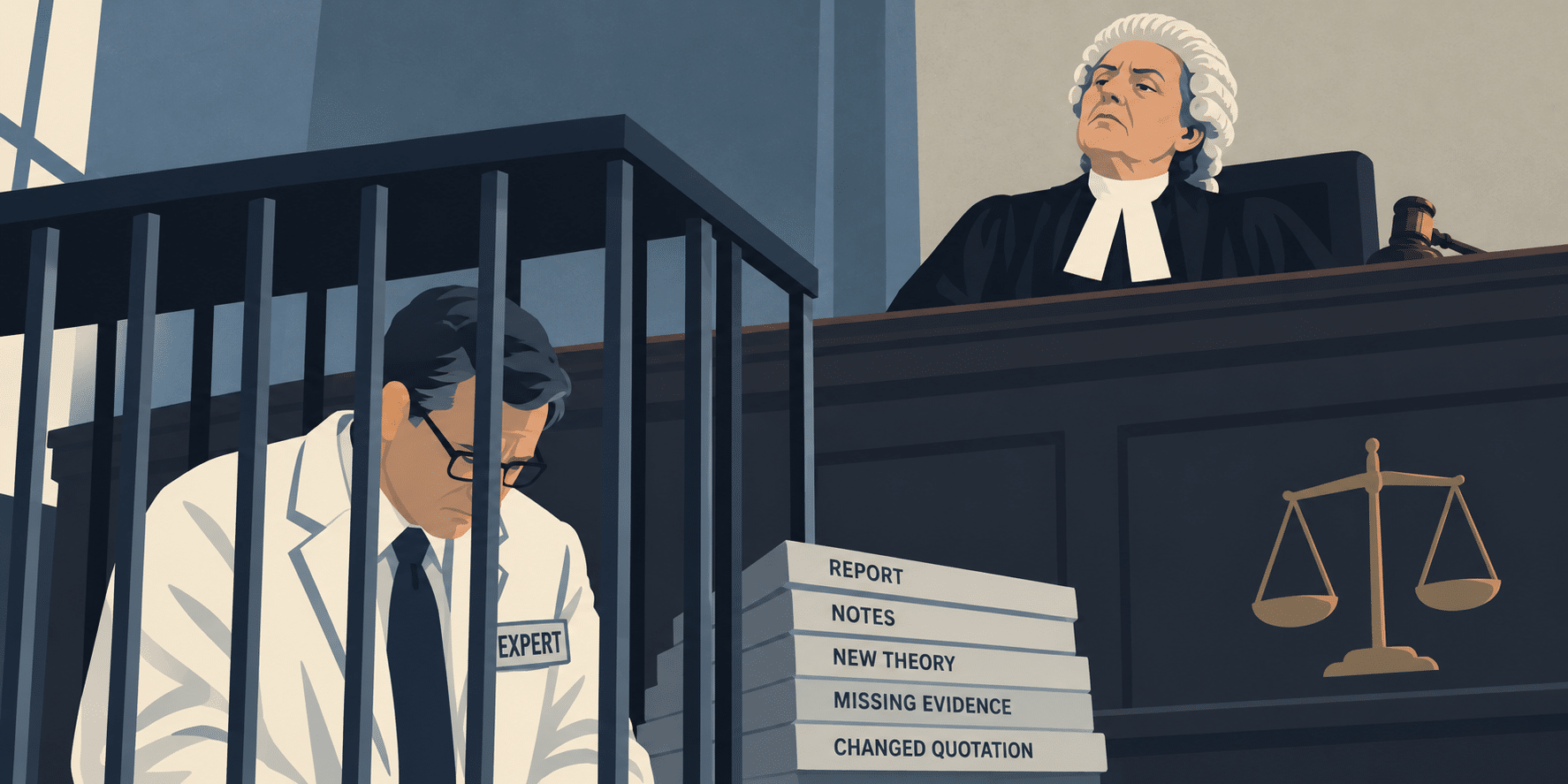
How often do you see an expert witness themself become part of the reason a criminal conviction is overturned?
That is, in effect, what happened in The King v ZX [2025] NICA 76, a decision of the Court of Appeal in Northern Ireland concerning convictions for murder and attempted murder.
Psychiatric evidence was central to the trial. The defendant’s mental state was directly relevant to the issues the jury had to decide, and both the prosecution and defence relied on psychiatric experts.
What makes the case particularly striking is not simply that the Court of Appeal disagreed with an expert’s opinion. Courts do that all the time. The problem went much deeper. The court concluded that the prosecution psychiatrist’s evidence had evolved in such a way that it could no longer be regarded as the independent product of an expert uninfluenced by the demands of the litigation.
The expert had, in the court’s words, effectively assumed an impermissible role in promoting the prosecution case.
That is an unusually serious finding against any expert witness.
An opinion which developed during the trial
Before trial, the prosecution psychiatrist had assessed the defendant as suffering from depression, although not to the degree suggested by the defence expert. During his oral evidence, however, he introduced a much more significant proposition: that the most likely explanation for what had happened was “spousal revenge”.
That theory had not appeared in his reports or his contemporaneous notes. It emerged in evidence after the expert had been provided with research material addressing that subject by prosecution counsel.
There were other examples of important matters appearing for the first time at trial. The expert placed weight on the condition of the defendant’s home as an indicator against severe depression, although that had not featured in his reports or notes. He also relied on the severity of her self-inflicted injuries in a way which had not previously been identified.
Experts are, of course, allowed to change their opinions. New information may emerge or further consideration may lead to a different conclusion. But a material change of view should be identified and communicated. A party should not discover an important new expert opinion for the first time when the expert is giving evidence.
That principle was central to the Court of Appeal’s reasoning.
A quotation which changed meaning
Perhaps the most uncomfortable factual detail concerned a quotation attributed to the defendant.
The expert’s report recorded her as saying:
“he destroyed my life, so I destroyed his”
When the expert’s original handwritten notes were eventually disclosed during the trial, however, they recorded only:
“he destroyed my life”
There was also a discrepancy about when the statement was said to have been made.
The difference is obvious. Adding the second half of the sentence changes a statement about what had happened to the defendant into something which appears retaliatory. That was particularly significant given the later emergence of the “spousal revenge” theory.
The court recorded that, when challenged in cross-examination, the expert at one stage agreed that he had lied about what had been said, although he later resiled from that position.
Whatever the explanation, it illustrates why an expert’s original notes can matter just as much as the final report.
Material which had not been considered
The problems were not confined to the development of new theories.
The expert accepted that he had not considered police body-worn footage, had not asked to see it and had not regarded it as part of his assessment. He had also failed accurately to record when, and to what extent, the defendant had received antidepressant medication. When these omissions were put to him, he maintained that they did not alter his opinion.
That poses a familiar problem for experts. A conclusion may ultimately remain the same after additional material is considered, but that is different from never having considered the material in the first place.
An expert needs to be able to explain not only the conclusion reached but the evidential basis on which it was reached, including material which points in the other direction.
The relationship between the expert and the legal team
The Court of Appeal was also highly critical of the way in which the prosecution expert had been handled.
Before giving evidence, the expert had a telephone conversation with prosecution counsel lasting between approximately 45 minutes and an hour. Neither participant made a note or record of the conversation. A further meeting took place on the day the expert began giving evidence.
The concern was not simply that discussions had taken place. Conferences between lawyers and experts are normal and often essential. The difficulty was what happened afterwards.
The court noted that matters raised during the consultation subsequently became prominent in the expert’s evidence and increasingly supportive of the developing prosecution case. It said this gave rise to an appearance of coaching or of the expert having been consciously or subconsciously influenced.
Importantly, the court did not make a finding of deliberate coaching, but it did find that the prosecution’s conduct had fallen below recognised standards of good practice.
There is a useful distinction here. Lawyers are entitled to test an expert’s opinion, challenge assumptions, ask questions and introduce new material. What they cannot properly do is shape the expert’s evidence into the case they want to present.
The expert has the corresponding responsibility to resist that process.
No written letter of instruction
Remarkably, the prosecution psychiatrist had no written letter of instruction.
The Public Prosecution Service explained that he had been given a brief verbal explanation of the case, but nothing had been put in writing.
The Court of Appeal’s response was blunt. It described that as “patently not good enough”, said that the practice lacked transparency and stated that in future experts in criminal cases should have a written letter of instruction.
For experts used to civil litigation, that may sound like an obvious requirement. But the reason for it goes beyond administration.
Written instructions establish what the expert was originally asked to consider. They help define the issues, provide a record of the material supplied and make it possible later to see how and why an opinion developed.
Without that starting point, it becomes much harder to distinguish independent analysis from a case theory which may have developed through conversations with the instructing team.
The court’s conclusion on independence
The Court of Appeal returned to well-established principles governing expert witnesses.
Expert evidence should be the independent product of the expert. An expert should provide objective and unbiased assistance to the court, should identify the facts and assumptions supporting an opinion, should not omit material facts which detract from it and should communicate any material change of view promptly.
Applying those principles, the court concluded that the prosecution psychiatrist had departed significantly from his role as an independent expert and had effectively assumed an impermissible role promoting the prosecution case.
The consequences were serious.
The court said that without the perseverance of defence counsel in obtaining the expert’s notes and examining his dealings with prosecution counsel, there was a real possibility that the deficiencies and partiality in the evidence would never have been exposed. It said that this could have led to a miscarriage of justice.
The ground of appeal relating to the expert evidence succeeded.
The responsibility did not stop with the expert
It would nevertheless be wrong to treat ZX simply as a case about an expert who lost his independence.
The Court of Appeal also found serious problems in the conduct of the prosecution and in the way the trial judge dealt with the difficulties once they had emerged.
The prosecution’s handling of the expert was criticised, including the informal nature of the instructions, delayed disclosure and the interaction between counsel and the expert. The ground of appeal relating to prosecutorial misconduct also succeeded.
The court also found that the trial judge had failed to give sufficient consideration to applications to discharge the jury. It concluded that the jury could easily have been misled by the expert evidence and that directions could not have cured the resulting prejudice.
Both convictions were quashed.
The court’s overall conclusion was that the serious errors began with the prosecution’s misconduct and were compounded by the expert witness and the judge.
Could a new expert start again?
There is one final aspect of the case which is particularly interesting for anyone involved in expert evidence.
Once the convictions had been quashed, the court had to consider whether a retrial could take place. One difficulty was that the “spousal revenge” theory had by then become embedded in the case papers.
The Court of Appeal was concerned that any new expert might themselves be influenced by that history simply by reading the existing material. It described the risk of the replacement expert becoming “contaminated”.
When a retrial was eventually ordered, the court directed that the new expert’s letter of instruction should, so far as possible, be prepared on a “blank page basis”.
That is perhaps one of the most thought-provoking parts of the judgment.
Expert independence is not only about resisting pressure from the party instructing you. It also means being alert to the way in which the material provided to you can frame the problem before you have even begun your own analysis.
Independence can be lost gradually
Most experts know that their duty is to the court rather than to the person paying their fees. It is one of the first principles of expert witness work.
What ZX demonstrates rather starkly is how independence can be eroded without there necessarily being one obvious moment when the line is crossed.
A discussion takes place. A new theory is raised. A piece of research is introduced. Something which seemed insignificant in the report becomes central in oral evidence. Material which does not fit the emerging theory receives less attention. Gradually, the expert stops simply assisting the court and begins to move with the case being advanced by one side.
That is why the disciplines around expert evidence matter: clear written instructions, complete records, contemporaneous notes, proper disclosure, transparency about changes of opinion and a willingness to consider evidence which does not support the preferred conclusion.
None of those things is glamorous. They are, however, part of what keeps an expert independent.
In ZX, their absence contributed to something very unusual indeed: the expert’s own conduct became part of the reason two criminal convictions could not safely stand.
Case: The King v ZX [2025] NICA 76, Court of Appeal in Northern Ireland.