
Article published: 23 November 2026
Key points
- Judge criticised “meaningless management jargon”; expert reports should be transparent and understandable; technical terminology may be necessary but should be explained; experts should scrutinise the provenance and quality of information supplied to them.
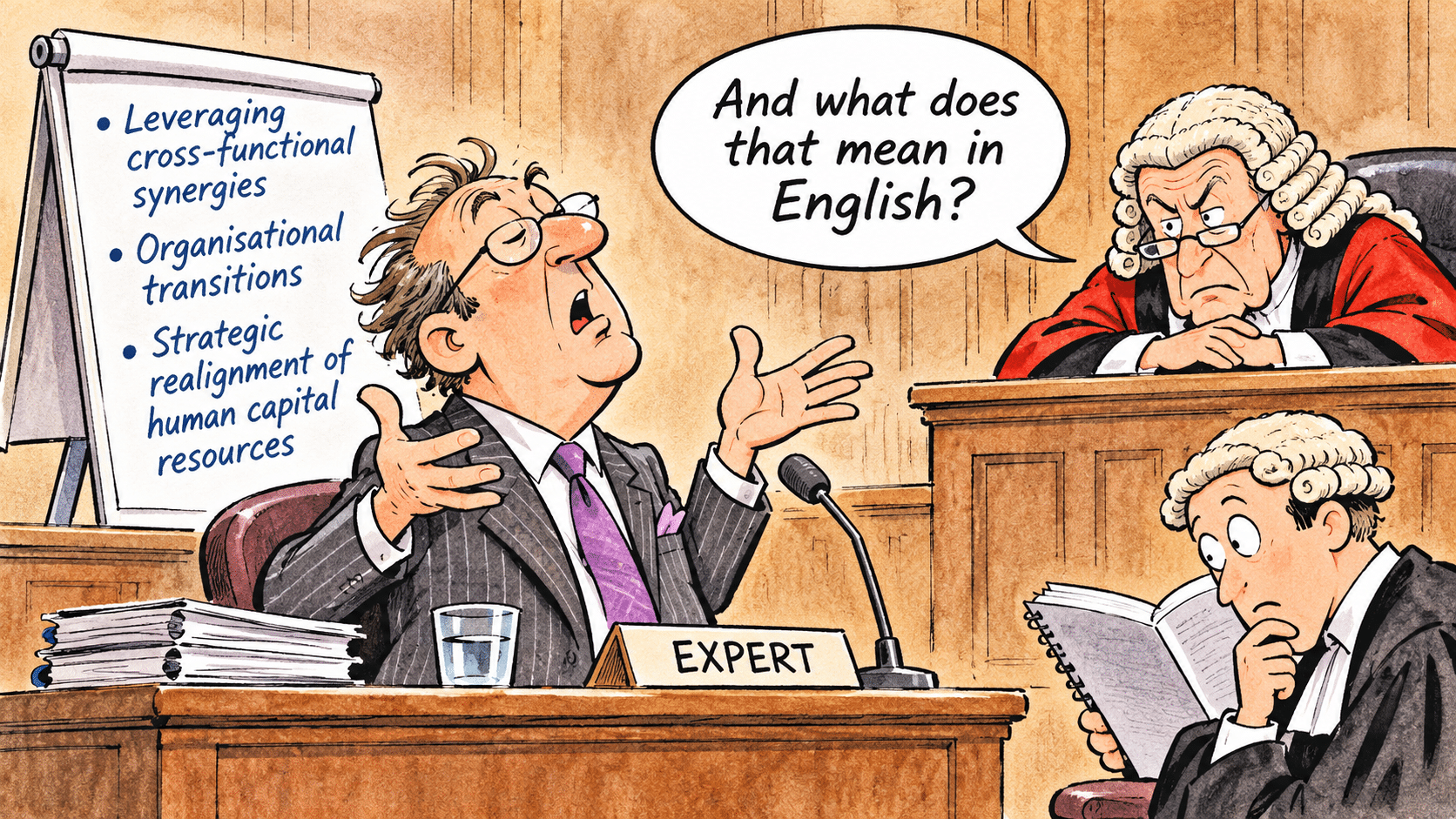
Jargon, and especially management jargon (often referred to in less savoury terms!), is abundant in the professional world. From “leveraging cross-functional synergies” (working together) to “a strategic realignment of human capital resources” (sacking people), there is seemingly no shortage of ways to make relatively straightforward matters sound unnecessarily complicated.
It clearly did not impress Mr Justice Andrew Baker in a recent Commercial Court judgment. Whilst the case concerned factual rather than expert evidence, his observations have considerable relevance to the preparation of expert reports and, in particular, the importance of communicating clearly with the intended reader.
The Case
Happy CP Company Limited v Craig Simon Smith [2026] EWHC 2981 (Comm)
The case concerned the enforcement in England of an arbitration award made in Hong Kong in February 2024.
The claimant had obtained an order permitting enforcement of the award under section 101 of the Arbitration Act 1996. The application was made without notice and was supported by a solicitor’s witness statement indicating that the sums awarded remained outstanding in full.
By the time the enforcement order was made, however, payments totalling US$154,000 had already been received from the seller. These payments had not been brought to the attention of the claimant’s solicitors or, consequently, the court.
When the position became apparent, a further witness statement was prepared correcting the information and seeking to explain the omission.
The claimant accepted that there had been material non-disclosure but argued that the enforcement order should be varied rather than set aside.
The Judgment
The explanation for the omission included a reference to “disruptions caused by organisational transitions”, together with a suggestion that the repayments had been irregular and sporadic, making them difficult to identify.
At paragraph 36 of his judgment, Mr Justice Andrew Baker described the reference to organisational transitions as:
“a reliance upon meaningless management jargon, uninformative as to what went wrong.”
The judge also observed that the suggestion that payments had been irregular and sporadic was not readily supported by the payment history. He questioned why the payments should have been difficult to identify given the ability to search digital banking records.
There was a further difficulty with the evidence. The solicitor had attributed information to the claimant without identifying the individual or individuals who had actually supplied it. As a result, the court was unable properly to assess whether the explanation came from someone with relevant knowledge of the events.
Importantly, the judge did not question the honesty of the solicitor. He distinguished between accepting that the solicitor had accurately reported what he had been told and accepting the quality of the explanation itself.
The judge did not consider that the non-disclosure had been deliberate, although he identified significant fault within the claimant organisation in approving the original application without adequately checking its accuracy.
The court ultimately declined to set aside the enforcement order, instead allowing it to be varied to ensure that appropriate credit was given for payments received.
Commentary
Writing for the layman
Part of the art of writing an expert report is making it transparent and understandable to the layman without losing its technical precision.
As experts, we spend much of our professional lives communicating with colleagues who share our knowledge, understand our terminology and speak the same professional language. Within that environment, technical shorthand can be an efficient and entirely appropriate means of communication.
The readership of an expert report is, however, rather different. A judge, arbitrator or solicitor may have little or no experience of the expert’s particular discipline. Indeed, that lack of specialist knowledge is often the very reason why the expert has been instructed.
We therefore need to consider not only whether what we have written is technically correct but whether the intended reader will understand it.
There is little benefit in explaining an unfamiliar technical concept by reference to another equally unfamiliar one.
Technical terminology and jargon
There is an important distinction between technical terminology and jargon.
A medical expert may need to use precise anatomical terminology, an engineer may need to describe particular physical processes and an accountant may need to explain complex accounting treatments.
Replacing established technical terms with everyday expressions can sometimes result in a loss of accuracy. The answer is not necessarily to remove the technical terminology but to explain it.
Management jargon, on the other hand, can obscure what has actually happened. Consider some familiar expressions:
- “Suboptimal resource allocation” (insufficient resources).
- “A breakdown in information flows” (information wasn’t passed on).
- “A failure of stakeholder engagement” (someone wasn’t consulted).
- “An unplanned operational discontinuity” (something stopped working).
Even the simplified versions of these expressions may not be sufficient for an expert report. What information was not passed on? Who should have received it? What stopped working, and why? What were the consequences?
It is the explanation of the underlying events, rather than the label attached to them, that is likely to assist the court.
The information on which we rely
The judge’s criticism of the quality and provenance of the information supplied to the solicitor is equally relevant to experts.
We will frequently receive information through those instructing us, sometimes in the form of explanations prepared by individuals within an organisation.
An expert investigating a machinery failure might, for example, be told that the equipment had been subject to an appropriate maintenance regime. That is rather different from being provided with maintenance records identifying what work was undertaken, when it was carried out and by whom.
Similarly, an expert investigating financial losses may be provided with a management explanation for a reduction in turnover. The expert will need to consider the extent to which that explanation is supported by the underlying financial and operational evidence.
Experts cannot necessarily verify every piece of factual information provided to them, nor is it their function to resolve every factual dispute. They should, however, distinguish between matters they have established, information they have been given and assumptions on which they have been asked to proceed.
Where the reliability of that information has a material bearing on the expert’s opinion, the implications should be apparent to the reader.
The expert’s duty to assist the court
Under CPR 35.3, an expert’s duty is to help the court on matters within their expertise. That duty overrides any obligation to those instructing or paying them.
Practice Direction 35, paragraph 3.2, sets out requirements for the contents of an expert’s report, including identifying material relied upon, setting out the substance of material facts and instructions, distinguishing matters within the expert’s own knowledge and explaining the reasons for opinions where there is a range of opinion.
Compliance with these requirements involves more than simply including the necessary information somewhere within the report. The information needs to be communicated in a way that enables the reader to understand its significance.
A technically correct report can still be difficult to follow if its reasoning is obscured by unnecessary jargon, unexplained terminology or poorly identified assumptions.
Reviewing the report
When reviewing an expert report before it is finalised, it may be worth considering:
- Would someone outside my profession understand what I have written?
- Have I explained unfamiliar technical terminology and abbreviations?
- Have I identified the material sources of my information?
- Have I distinguished between facts, assumptions and opinions?
- Have I explained what actually happened rather than simply described it using professional terminology?
- Can the reader understand how and why I reached my conclusions?
The ability to communicate complex matters clearly is an important part of the expert witness’s skill. Possessing specialist knowledge and being able to communicate that knowledge effectively are two quite different things.
A good expert report should enable the reader to understand not only the expert’s conclusions but also how and why they were reached. We are only going to make that more difficult if the reader first has to decipher the language in which the report is written.
Key Points for Experts
- An expert report should be transparent and understandable to the layman without sacrificing technical precision.
- Technical terminology should be explained where necessary; jargon should not be a substitute for explanation.
- Experts should scrutinise the quality and provenance of information provided by others.
- Accurately repeating information supplied by another person does not necessarily establish its reliability.
- The reader should be able to follow the expert’s reasoning from the underlying evidence to the conclusions reached.
Articles reflect the law and practice at the time of original publication, except where a dated update is shown. Subsequent developments may affect their relevance or accuracy. They are provided for general information and do not constitute legal or professional advice. Obtain appropriate advice on your particular circumstances. Full disclaimer.